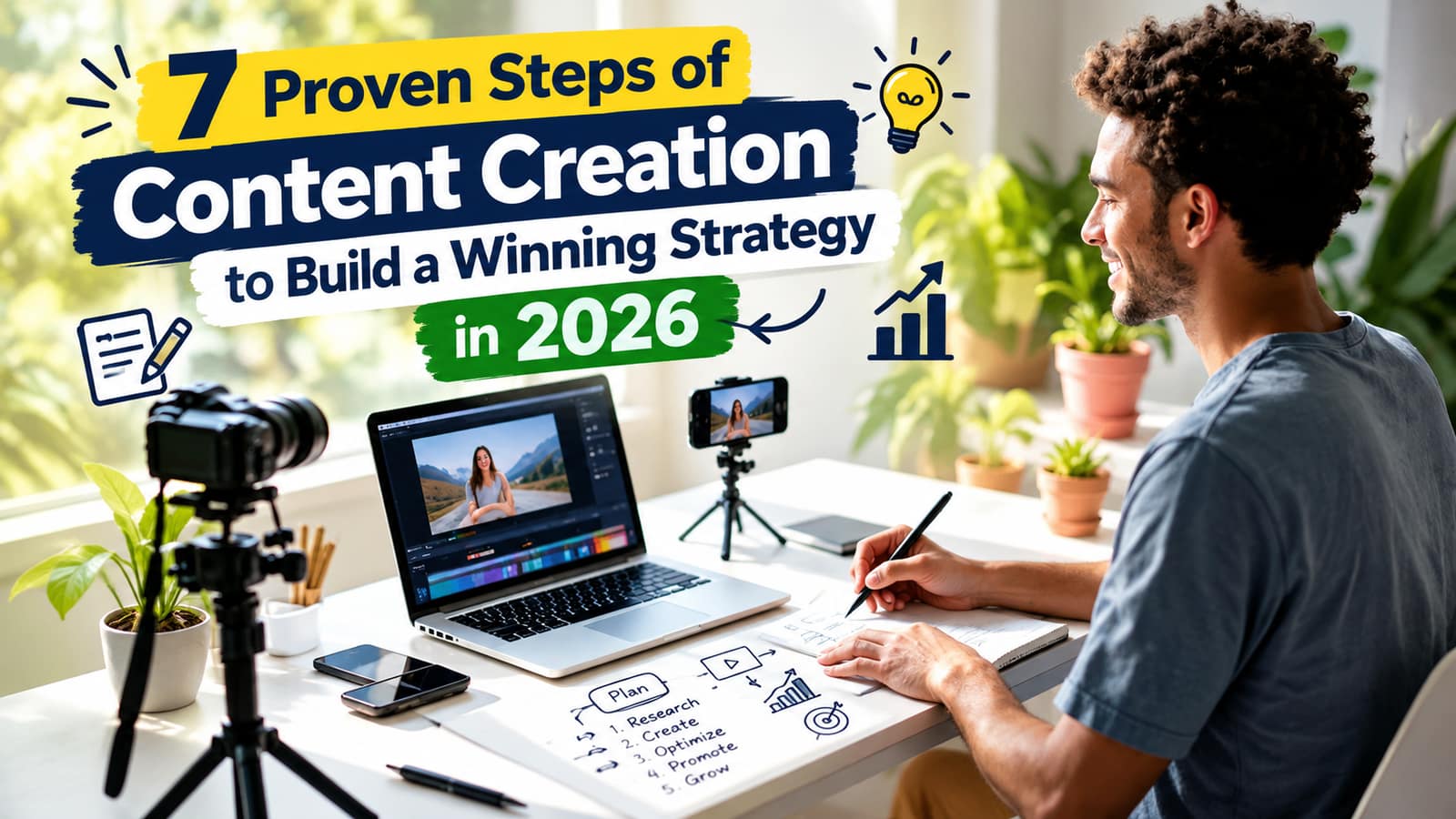
A solo creator filming in their bedroom and a marketing team producing a quarterly report are technically doing the same job — making something and sharing it with an audience. The goals differ, but the process underneath is the same. This guide covers both, with a few forks in the road worth knowing before you commit your time to one.
1. Definition and Overview of Content Creation
Content creation is the process of making and sharing material — written, visual, audio, or video — to inform, entertain, or connect with a specific audience. It sits one level below content marketing, which is the strategic use of that material to drive business goals, and one level below content strategy, the planning layer that decides what gets made, for whom, and why.
The short version:
- The core process is the same whether you’re a solo creator or a brand, even though the goals differ.
- There’s no universal “best” format — the right one depends on what you can actually sustain.
- AI is now part of most workflows, and being upfront about how you use it matters more than people realize.
- Betting everything on one platform is a real risk, not just a cautionary cliché — a point the creator economy‘s growth has made more visible, not less.
- Consistency beats perfection, almost every time.
2. Creator vs. Brand: Two Audiences, One Process
If you’re building something under your own name — a YouTube channel, a newsletter, a personal following — your wins look like audience growth, engagement, and eventually income. If you’re making material for a company, your wins look like leads, brand awareness, and sales. Worth knowing: only a small slice of any audience ever becomes active creators themselves.
A pattern long observed online and often called the 1% rule, where roughly 1% of a community’s users produce nearly all of its content and everyone else mostly watches. That’s true whether you’re building a personal following or a brand audience, and it’s one reason consistency from the few who do create matters so much.
3. The Content Creation Process: 7 Steps

Strip away the jargon, and making good material follows a rhythm, regardless of format.
3.1 Research
Before writing a word or hitting record, find out whether anyone’s actually looking for what you’re about to make. Keyword research — checking real search demand for a topic — covers this for search-driven material; for social content, it means checking what’s already resonating in your niche. Skipping this step is the single most common reason a piece falls flat.
3.2 Ideation
Take what you learned and turn it into a real list of ideas, not just one. Many teams organize this around a topic cluster model: one long-form “pillar” piece covering a subject broadly, linked out to several narrower pieces that go deeper on related angles — a structure that makes brainstorming far less random than it sounds.
3.3 Content Creation
This is where your actual skill comes in — writing, filming, designing, recording. A buyer persona (for brand content) or an audience persona (for individual creators) — a semi-fictional sketch of who you’re actually making this for — earns its keep here, since it shapes tone and detail far more than people expect. Tools like Canva for visuals or HubSpot’s AI Content Writer for a first draft can speed this stage up, but aim for one clear idea per piece regardless of tool. Cramming three points into one video or post usually means none of them land.
3.4 Editing
Come back to your draft after a break, if you can. Grammar and readability tools — Grammarly and the Hemingway Editor are two widely used examples — catch what tired eyes miss, but no tool replaces reading your own work the way a stranger would.
3.5 Publishing
Don’t just hit send the moment something’s done. A consistent schedule builds an audience that knows when to expect you, and that expectation is worth more than it sounds.
3.6 Promotion
Nobody finds great material by accident anymore. Share it across owned channels you control directly, lean on earned attention from people sharing it unprompted, consider paid promotion where it makes sense, and look for syndication opportunities — other sites or publications picking the piece up. One push rarely does the job alone.
3.7 Analysis
Look at what worked and what didn’t, then let that shape your next round of ideas. This step is the one most people skip, and it’s the one that compounds the most over time.
4. Choosing a Content Format

Nearly every guide on content creation hands you a list of formats — blog, video, podcast, social — and lets you pick based on vibes. That’s backwards. Pick based on three honest questions instead.
4.1 Can you actually sustain it?
A weekly podcast abandoned after six episodes does less for you than a biweekly blog kept up for two years.
4.2 Where does your audience already spend time?
Short, punchy video belongs on TikTok and Instagram Reels, where discovery runs on the algorithm. Long-form thinking belongs in a newsletter or blog, where discovery runs on search or direct opt-in. Match the format to where people already look.
4.3 What’s your real starting skill?
Writing has the lowest barrier to entry. Video and audio both carry a real technical learning curve before the content itself even gets good.
| Format | Resource intensity | Skill floor | Typical discovery path |
| Blog/written | Low to moderate | Low | Search engines |
| Short-form video | Moderate | Moderate | Platform algorithms |
| Long-form video | High | High | Search + subscriptions |
| Podcast | Moderate to high | Moderate | Directories, word of mouth |
| Newsletter | Low to moderate | Low | Direct opt-in |
| Social/image posts | Low | Moderate | Platform algorithms |
5. Building a Content Strategy

A plan keeps you from spending months making content creation that go nowhere. Start with a goal framed using the SMART method — Specific, Measurable, Achievable, Relevant, Time-bound — rather than something vague like “grow my audience” with no deadline attached.
From there, build out that persona mentioned earlier: a rough sketch of your ideal reader or viewer, including their problems and where they spend time online. It makes every later decision easier, from topic choice to tone. Then build a simple content calendar. It doesn’t need to be elaborate — knowing what you’re publishing, where, and when is usually enough to stay consistent, which matters more than the calendar tool itself.
6. Promoting and Distributing Content

content creation is only half the job, and the four channels named in step 3.6 — owned, earned, paid, syndicated — are worth returning to here as a deliberate mix rather than a one-time list. Most creators lean almost entirely on whichever platform they started on, and that’s worth reconsidering, for reasons the next two sections make concrete.
7. Building a Content content creation Strategy

AI is already part content creation now — brainstorming topics, drafting a first pass, speeding up editing. Used well, it saves real time. Used carelessly, it produces something flat that audiences can often tell apart from something made by a person.
A practical way to think about content creation: using AI to brainstorm or clean up grammar is light-touch, and nobody expects a footnote for that. Using AI to generate most of a piece’s actual substance is different, and audiences increasingly notice whether that gets acknowledged — a concern researchers studying deepfakes and AI-generated misinformation have flagged as a genuine, growing risk, not a hypothetical one.
Major platforms are moving toward requiring AI-content labeling; specifics differ and change often, so check current policy directly rather than assuming last year’s rules still apply. The same AI tools that draft content can also help check how visible that content is to AI search assistants — HubSpot’s AI Search Grader is one example, built for the emerging discipline sometimes called answer engine optimization, or AEO.
8. Platform Risk and Content Diversification
The platform you’ve built your audience on doesn’t belong to you. Enforcement systems differ by platform and shift over time: YouTube runs a three-strike system escalating from warnings to demonetization to removal, TikTok uses tiered enforcement moving from warnings to feature restrictions to permanent bans, and Meta’s Community Standards govern Facebook and Instagram, though its political fact-checking has notably scaled back since 2025. None of this is a reason to panic. It’s a reason to build something alongside your platform presence that you actually own.
An email list is the clearest example of — nobody can algorithm-change your way out of someone’s inbox. A website works the same way. Treat your platform following as valuable but rented, and your owned audience as the thing that’s actually yours. It’s also worth knowing that heavily personalized, algorithm-driven feeds can trap both creators and audiences inside a filter bubble, where the same narrow slice of content keeps circulating — one more reason a mixed, owned-plus-platform approach tends to hold up better over time.
9. Measuring Performance

You don’t need to track everything — just the numbers tied to your real goal. For reach, watch page views and organic traffic. For relevance, watch bounce rate — the share of visitors who leave after one page. For audience connection, watch engagement rate, interactions measured against reach. For business impact, watch conversion rate and click-through rate. For long-term SEO strength, domain authority is the metric worth revisiting periodically rather than daily. Pick the few that match your actual goal, and check them on a rhythm you’ll keep up.
10. Monetization Models

For individual content creators, the common paths are sponsorships, ad revenue (YouTube’s Partner Program is the best-known example), affiliate marketing, selling digital products or courses, and memberships from a loyal audience. For brands, content usually isn’t sold directly — it earns its keep through lead generation, converting readers into sales further down the line.
A quick legal note worth knowing either way: original material is automatically protected, and in the US the Digital Millennium Copyright Act governs how creators can act against unauthorized use, while Creative Commons licensing offers a voluntary alternative for anyone who wants to share work more openly than standard copyright allows.
11. Frequently Asked Questions
1 Definition of content creation
Making and sharing material — written, visual, audio, or video — to inform, entertain, or connect with an audience.
2 Content creation vs. content marketing
Content creation is making the material itself; content marketing is the broader strategy behind why and how you use it.
3 Skills needed to get started
Writing is the easiest entry point in content creation; video, audio, and design all carry a steeper technical learning curve worth planning for.
4 How to choose a format
Pick based on what you can sustain consistently and where your actual audience already spends time, not personal preference alone.
5 Disclosing AI use
Light touch-ups don’t need a mention; material where AI did most of the heavy lifting generally should be disclosed.
6 Number of platforms to use
Fewer platforms done consistently beats many done poorly — pair at least one with an owned channel like email for protection.
7 How creators make money
Sponsorships, ad revenue, affiliate marketing, digital products, and memberships are the most common paths.
12. Conclusion
This work rewards people who start before they feel ready and keep going longer than feels comfortable. Pick one format that fits where you are right now, build a simple plan of around it, and let your first few months of results — not your assumptions — tell you what to adjust.